

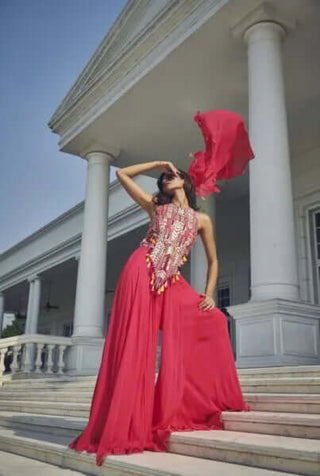


The anarkali is not merely a silhouette. It is a reference — to Mughal courts, to classical dance, to a particular understanding of femininity that has persisted across centuries of South Asian dressing. The Noor-e-Anarkali Set honors that lineage without being imprisoned by it.
Crafted from chanderi silk in luminous ivory, the anarkali's full, floor-length panels are woven with a subtle gold zari ground — a self-pattern that only reveals itself in direct light. Over this, ari embroidery traces botanical and floral motifs across the flared skirt, while pita ribbon-work and sitara disc embellishments concentrate their brilliance at the yoke, creating a focal point that draws the eye upward before the hem's heavily embroidered border anchors it back down.
A sheer organza dupatta adds airiness to an otherwise structured silhouette. The soft net-lycra churidar, gathered at the ankle in traditional fashion, completes what is unmistakably a garment for ceremony.
Reach for it at nikah celebrations, engagement ceremonies, walima receptions, bridal showers, and any occasion that calls for ivory over red — and the quiet confidence that choice requires.
Crafted from chanderi silk in luminous ivory, the anarkali's full, floor-length panels are woven with a subtle gold zari ground — a self-pattern that only reveals itself in direct light. Over this, ari embroidery traces botanical and floral motifs across the flared skirt, while pita ribbon-work and sitara disc embellishments concentrate their brilliance at the yoke, creating a focal point that draws the eye upward before the hem's heavily embroidered border anchors it back down.
A sheer organza dupatta adds airiness to an otherwise structured silhouette. The soft net-lycra churidar, gathered at the ankle in traditional fashion, completes what is unmistakably a garment for ceremony.
Reach for it at nikah celebrations, engagement ceremonies, walima receptions, bridal showers, and any occasion that calls for ivory over red — and the quiet confidence that choice requires.
Size Guide
Measuring Guide
Measuring Guide


Delivery in 15-20 Days
Secure payment
Shipping calculated at checkout.
The anarkali is not merely a silhouette. It is a reference — to Mughal courts, to classical dance, to a particular understanding of femininity that has persisted across centuries of South Asian dressing. The Noor-e-Anarkali Set honors that lineage without being imprisoned by it.
Crafted from chanderi silk in luminous ivory, the anarkali's full, floor-length panels are woven with a subtle gold zari ground — a self-pattern that only reveals itself in direct light. Over this, ari embroidery traces botanical and floral motifs across the flared skirt, while pita ribbon-work and sitara disc embellishments concentrate their brilliance at the yoke, creating a focal point that draws the eye upward before the hem's heavily embroidered border anchors it back down.
A sheer organza dupatta adds airiness to an otherwise structured silhouette. The soft net-lycra churidar, gathered at the ankle in traditional fashion, completes what is unmistakably a garment for ceremony.
Reach for it at nikah celebrations, engagement ceremonies, walima receptions, bridal showers, and any occasion that calls for ivory over red — and the quiet confidence that choice requires.
Crafted from chanderi silk in luminous ivory, the anarkali's full, floor-length panels are woven with a subtle gold zari ground — a self-pattern that only reveals itself in direct light. Over this, ari embroidery traces botanical and floral motifs across the flared skirt, while pita ribbon-work and sitara disc embellishments concentrate their brilliance at the yoke, creating a focal point that draws the eye upward before the hem's heavily embroidered border anchors it back down.
A sheer organza dupatta adds airiness to an otherwise structured silhouette. The soft net-lycra churidar, gathered at the ankle in traditional fashion, completes what is unmistakably a garment for ceremony.
Reach for it at nikah celebrations, engagement ceremonies, walima receptions, bridal showers, and any occasion that calls for ivory over red — and the quiet confidence that choice requires.